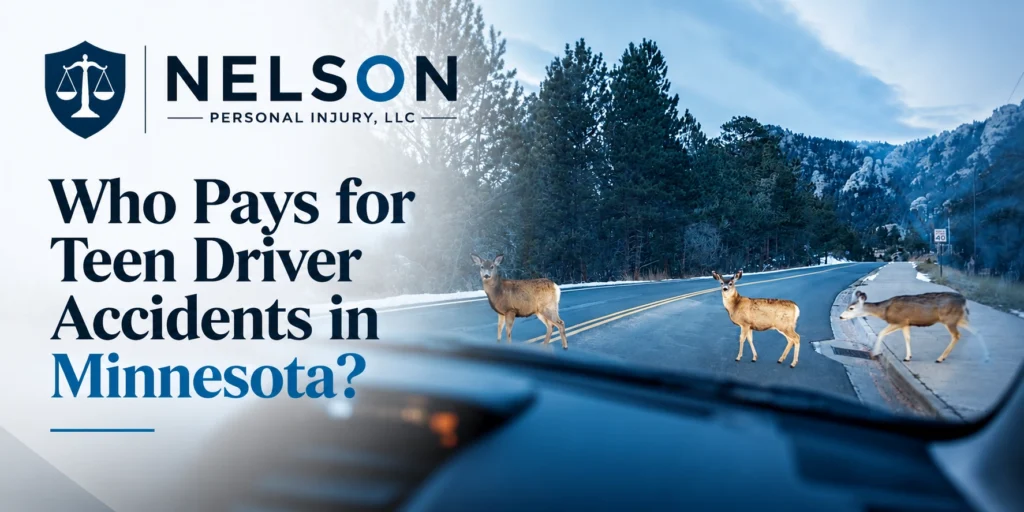
If you hit a deer in Minnesota, focus on four things: get your vehicle off the road, call 911 if anyone is hurt, stay away from the animal, and document the damage before you call your insurer. A deer strike is usually a comprehensive claim, and your no-fault coverage pays injuries first.
Deer crashes peak in Minnesota every October and November, as the rut and firearms deer season bring more animals onto roads around St. Cloud, Elk River, Alexandria, and the northwest Twin Cities suburbs. In this guide, Nelson Personal Injury LLC walks through post-strike safety steps, the state’s reporting and deer-possession rules, and which insurance coverage pays for the vehicle and the people inside it. If someone was hurt, our Minnesota car accident attorneys can explain your options at no cost.
Key Takeaways
- Pull fully onto the shoulder, turn on your hazard lights, and call 911 if anyone is injured or the deer is blocking a lane.
- Do not approach or touch a deer that is still alive. A wounded deer can kick, and it may get up and leave on its own.
- Under Minn. Stat. 169.09, subd. 6, a crash that injures or kills a person must be reported to law enforcement by the quickest means available.
- Hitting a deer is usually a comprehensive claim. If you swerve to avoid the deer and hit a tree, a ditch, or another car, it’s usually a collision claim.
- Minnesota no-fault (PIP) benefits cover your medical bills and lost wages regardless of fault, up to $20,000 each under Minn. Stat. 65B.44.
- A Minnesota resident who wants to keep the deer must get a possession permit from a law enforcement or conservation officer before taking it.
What should you do right after hitting a deer?
The first priority is to prevent a second crash. Deer strikes usually happen on dark, fast roads such as Highway 10 between Elk River and St. Cloud, Interstate 94 near Alexandria, and the county roads around Maple Grove, and a stopped car in a travel lane is a serious hazard. Follow these steps in order.
Step-by-step after a deer strike
- Slow down smoothly, signal, and pull as far onto the shoulder as you safely can. Turn on your hazard lights.
- Check yourself and your passengers for injuries. Call 911 if anyone is hurt, if airbags deployed, or if the deer or your vehicle is blocking traffic.
- If traffic is heavy, stay in the vehicle with your seat belt on. If you must get out, exit on the side away from traffic.
- Keep your distance from the deer. A stunned animal may recover and run, and a dying one can injure you with its hooves.
- Take photos of the vehicle damage, the deer’s location, the road, and any skid marks, and note the time, weather,r and exact spot (highway, mile marker, or nearest cross street).
- Call the local police department, the State Patrol, or the county sheriff if the deer is dead on the roadway, if the crash caused injury, or if you want to claim the animal.
- Check whether the vehicle is safe to drive. Leaking fluids, a damaged radiator, a loose hood, or broken headlights mean you should call a tow.
- Report the strike to your insurer the same day, and get checked by a doctor even if you feel fine. Soft tissue injuries often show up a day or two later.
The Minnesota Department of Public Safety Office of Traffic Safety also urges drivers not to swerve. In its deer-vehicle safety guidance, the agency notes that swerving can send a vehicle into oncoming traffic or off the road, and that braking firmly while holding your lane is usually the safer choice.
Do you have to report hitting a deer in Minnesota?
You do not have to file a report for a deer strike that only damages your vehicle, but you must report any crash that injures or kills a person. Minn. Stat. 169.09, subd. 6 requires the driver to notify the local police department if the crash is inside a city, the State Patrol if it is on a trunk highway such as I-94 or Highway 10, or the county sheriff anywhere else, by the quickest means of communication.
The older rule that required a written driver report to the state for property damage above a dollar threshold was repealed in 2021 and no longer applies. Today the investigating officer, not the driver, files the crash report with the Department of Public Safety. Even when a report is not legally required, calling law enforcement is smart for three reasons: a dead deer in the lane is a hazard for the next driver, an officer’s report supports your insurance claim, and you need an officer involved if you want to keep the deer.
Can you keep a deer you hit in Minnesota?
Yes, with a permit. Under Minn. Stat. 97A.502, the driver who kills a deer on a public road has first priority for a possession permit covering the entire animal. According to the Minnesota DNR, conservation officers and local law enforcement issue the permit at no charge, and someone else can take the carcass at the scene. If no one claims a salvageable deer, the road authority removes it.
Is hitting a deer comprehensive or collision?
Hitting a deer is a comprehensive claim under nearly every auto policy. Comprehensive coverage pays for damage that is not caused by a collision with another vehicle or object, and insurers treat contact with an animal as an unavoidable event rather than a driving error. As a result, a comprehensive claim generally won’t raise your rates the way an at-fault collision claim can.
Collision coverage applies when you swerve to miss the deer and hit something else: a tree, a guardrail, a ditch, a mailbox, or another car. In that situation,n you never touched the animal, so the insurer sees a single-vehicle collision. The practical lesson from the State Patrol matches the insurance lesson. Brake hard, stay in your lane, and let the deer be the thing you hit.
Does insurance cover hitting a deer if you only carry liability?
No. Minnesota requires every driver to carry liability, no-fault, and uninsured and underinsured motorist coverage, but comprehensive and collision are optional. If you drop comprehensive to save money, you pay out of pocket for damage from a deer strike. Your no-fault benefits for injuries still apply, because those are part of the required coverage.
Who pays for injuries after a deer crash?
Your own no-fault policy pays first, no matter who or what caused the crash. Minnesota’s no-fault law, Minn. Stat. 65B.41 to 65B.71, requires every policy to include basic economic loss benefits, often called personal injury protection (PIP). Under Minn. Stat. 65B.44, those benefits provide at least $20,000 for medical expenses and another $20,000 for lost income, replacement services, and related losses for each injured person.
Passengers are covered too. A passenger generally claims first under their own policy, if they have one; otherwise, under the policy for the vehicle they were riding in. Notice to the insurer should go in promptly; Minn. Stat. 65B.55 lets a policy require notice within as little as six months, so do not wait. Our page on Minnesota no-fault car accident claims explains how to open a claim, and our separate guide to Minnesota no-fault insurance and PIP coverage covers the thresholds, exclusions, and motorcycle rules in detail.
When does a deer crash become a liability claim?
A deer crash becomes a liability claim when another driver’s choices caused your injuries. Common examples include a driver who swerves for a deer and crosses the center line into you, a driver who stops dead in a lane and gets rear-ended, or a driver who hits a deer and then another vehicle because of speed, distraction,n or impairment. In those cases, once your injuries pass Minnesota’s no-fault thresholds, you may file a claim against the at-fault driver’s liability coverage for pain, suffering, and losses PIP doesn’t cover.
Multi-vehicle deer crashes are common on divided highways where traffic moves fast, which is why highway accident claims around I-94, I-694, and Highway 169 often involve more than one insurer. Minnesota’s comparative fault rules can reduce a recovery if you share blame, so how the crash is documented matters.
When and where are deer crashes most likely in Minnesota?
Deer crashes cluster in the fall and at dusk. The Minnesota Department of Public Safety reports that deer-vehicle crashes peak in the autumn months, that deer are most active between 6 and 9 p.m., and that forested stretches are riskiest between dusk and dawn. The 2026 firearms deer season opens statewide on November 7, which pushes deer across roads during the same weeks the rut has bucks moving at all hours.
The toll is not small. In a DPS blog post on deer crashes, the agency counted 6,218 reported deer-vehicle crashes in Minnesota from 2016 through 2020, causing 18 deaths and 124 serious injuries, and it estimates that about two-thirds of deer strikes are never reported. Motorcyclists accounted for 15 of those 18 deaths. For riders, a deer strike is rarely a comprehensive-only event; it is often a serious injury case.
Common Mistakes Our Attorneys See After Deer Crashes
The deer itself is usually the simple part of the claim. The problems come from what happens in the hours and days afterward. Here are the missteps that cost people the most.
- Telling the insurer “I swerved and hit the deer” when the deer was actually struck in the lane. Word choice can move a claim from comprehensive to collision, so describe exactly what happened.
- Skipping the doctor. Adjusters treat a gap between the crash and the first medical visit as a sign the injury was minor or came from something else.
- Not calling law enforcement when a second vehicle was involved. Without an officer at the scene, the other driver’s story is the only one on record.
- Letting a dented hood hide frame or radiator damage. Have a shop inspect the vehicle before you accept a quick repair estimate.
- Assuming a passenger has no claim. Passengers have their own PIP benefits and, when another driver was negligent, their own liability claim.
- Waiting to report the crash to the no-fault insurer. Prompt notice protects your benefits and starts paying medical bills.
Frequently Asked Questions
Should I call the police if I hit a deer in Minnesota?
Call the police, the State Patrol, or the county sheriff if anyone is injured, the deer or your vehicle is blocking the road, or you want to keep the deer. Minnesota law requires reporting only for crashes that cause injury or death, but an officer’s report also makes an insurance claim easier to prove.
Does hitting a deer raise your insurance in Minnesota?
A deer strike is usually covered under comprehensive, and most insurers don’t treat a comprehensive claim as an at-fault accident for rating purposes. Swerving and hitting another object is a collision claim, which is more likely to affect your premium. Check your own policy, since rating practices vary by company.
Can I keep the deer I hit in Minnesota?
Yes, if you get a possession permit. Under Minn. Stat. 97A.502, the driver has first priority to claim a deer killed on a public road, and a conservation officer or local law enforcement officer can issue the permit at no charge. Do not load the deer before you have the permit.
Who pays my medical bills if I hit a deer?
Your own no-fault (PIP) coverage pays your medical bills and part of your lost wages regardless of fault, with at least $20,000 available for each category under Minn. Stat. 65B.44. If another driver caused the crash by swerving into you or hitting you from behind, you may also have a liability claim against that driver once your injuries meet Minnesota’s no-fault thresholds.
What if I hit a deer on my motorcycle in Minnesota?
Motorcycle riders aren’t covered by the no-fault PIP system the way car drivers are, so after a deer strike, medical bills go through health insurance, optional medical payments coverage, or a liability claim if another driver contributed to the crash. Minnesota DPS data shows motorcyclists accounted for most of the state’s deer-crash deaths, so riders should talk to an attorney early.
Talk to Nelson Personal Injury LLC After a Deer Crash
What to do if you hit a deer in Minnesota starts with safety and ends with the right insurance claim: comprehensive for the deer, collision for anything you swerved into, PIP for your injuries, and a liability claim when another driver’s choices put you in the hospital. The rules are straightforward, but how you report and document a claim in the first few days shapes what you recover.
Nelson Personal Injury LLC represents injured drivers, passengers, and motorcyclists from offices in Sartell and Maple Grove, serving St. Cloud, Elk River, Alexandria, Minneapolis,s and communities across Minnesota. If a deer crash left you or a family member hurt, our Minnesota car accident lawyers will review your no-fault and liability options, deal with the insurers, and explain what your claim is worth. Contact us for a free case evaluation, or call our Sartell office at (320) 208-9841 or our Maple Grove office at (763) 496-5877. There is no fee unless we recover for you.